University Life

Career Influencers Network Guides Career-Ready Students toward Success


This article originally appeared on The George on October 9, 2025 / By Lauren Reuscher

The Career Influencers Network at George Mason University empowers faculty and staff to provide career development support to students throughout their academic journey. The network is open to instructors, advisors, success coaches, supervisors, and any others across campus who are positioned to help students achieve their professional goals. 

University Career Services hosted a reception in early October honoring the network’s 10th anniversary. The network started in 2015 with 19 members, and it has now grown to include more than 500 faculty and staff. 


The network exemplifies George Mason’s approach to preparing career-ready graduates.

“The Career Influencers Network was the beginning of a ‘career ecosystem’ or ‘career everywhere’ approach,” said Saskia Campbell, executive director of University Career Services. “Preparing career-ready graduates is not confined to one office; it’s a shared responsibility of every faculty and staff member.”

The Carnegie Foundation and American Council on Education (ACE) has named George Mason to the highest tier of its list of Opportunity Colleges and Universities: Higher Access, Higher Earnings, in recognition of the university’s commitment to accessibility, return on investment, and upward mobility. Positive, high-earning career outcomes contribute to that recognition. 

Career Influencers offer students job-search advice, refer them to career advising, promote employer recruitment efforts at George Mason, and share career resources with students. 

“Campus partners have helped students connect the dots between their academic experiences or on-campus jobs and their professional futures—and that is transformative,” Campbell said.

The Career Influencers Network has garnered national attention—other institutions reach out for guidance to replicate its success on their own campuses. George Mason’s network has been highlighted by organizations supporting career services in higher education, including the American Association of State Colleges and Universities.

The network’s ability to reach students wherever they are has been instrumental to its success. 

“It’s a common challenge many career services offices face: how to serve a large student population with limited staff and resources,” said Kristin Leonato, associate director of programs and outreach in University Career Services. “Utilizing career services is optional and not a required part of a degree program. The network allows us to connect with campus partners who students already know and trust.”

To join the network, faculty and staff participate in an interactive, 4.5-hour training covering topics like career readiness, how employers recruit George Mason students, and strategies to support students at various stages of their career development.

Engagement with the network does not end with the initial training. Career Influencers receive ongoing support from University Career Services, including workshops on related topics and monthly updates on career-related events and services.

The 10th anniversary event included words of appreciation from Campbell and Rose Pascarell, vice president of University Life, who presented two awards recognizing faculty and staff contributions to the Career Influencers Network. 

Erin McSherry, assistant dean in the College of Humanities and Social Sciences (CHSS), received the Star Recruiter Award for having referred the most new members to the network. About 50% of the faculty and staff in the network are referred by a colleague or supervisor.
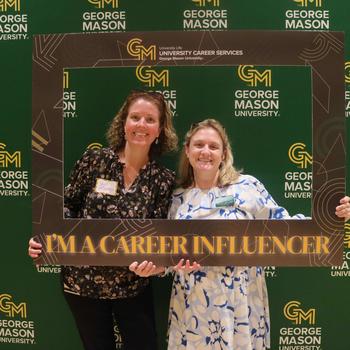
Erin McSherry, College of Humanities and Social Sciences (pictured at left), received the Star Recruiter Award for having referred the most new members to the Career Influencers Network. Pictured at right is Kristin Leonato, associate director, University Career Services. Photo provided

Larry Guerin, adjunct faculty in the Criminology, Law, and Society Department within CHSS, received the Outstanding Influencer Award for demonstrating the impact career influencers can make on students’ personal and professional lives. 

“It takes a strong network of committed professionals to support students in achieving their short-term and long-term professional goals in a wide range of career fields,” said Leonato. “The more than 500 faculty and staff in the Career Influencers Network are an important part of this work.” 
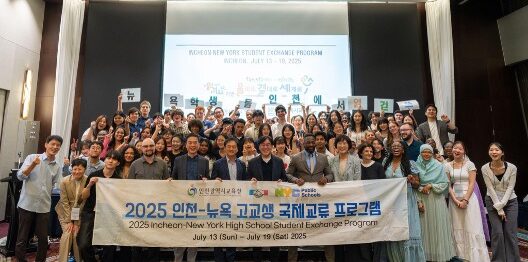
Mason Korea Students Take the Lead in New York High School Exchange Program


This article originally appeared on The George on September 17. Edited by Chelsea Xu, UL Marketing and Communications.

George Mason University Korea played a crucial role in connecting students from different cultures across language barriers over a seven-day Incheon–New York High School Exchange Program in July.

Education authorities from Incheon and New York have collaborated on a brand-new exchange in which students from the two cities shared classrooms and experiences while acknowledging the language and cultural barriers in between. 

The George Mason lead on the project — Hyunyoung Cho, a professor of English in Mason Korea — noted how ambitious the project was. “Last year, when the two cities’ authorities first met, we had no specific plan on how to implement this grand project,” she said. “However, with the effort of so many officials and schools, this became a reality and a truly historic starting point for more exchanges to follow.”

Mason Mentors at the Heart of the Exchange

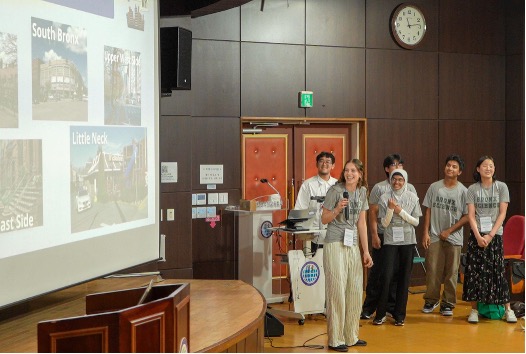
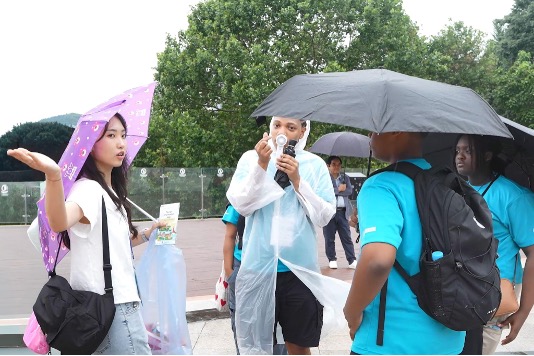
Five Mason Korea students—Chaeyoung Moon, Cheho Moon, Jisu Kim, Jungbin Eom, and Minsoo Kim—assisted Cho in planning and running the program. The Mason Korea students served as mentors and helped introduce the group to the new environments including classrooms, historic sites, and popular streets while drawing on what they learned in ENGH 300 Literature for the Public and Cross-cultural Communication.

Mentor Cheho Moon presents on the diversity of New York City with Bronx Science Students. Photo Provided.

Yoon-oh Noh, research officer at the Incheon East Asia Global Education Institute, said the mentors made this program especially distinctive. The student mentors functioned as primary cultural guides and instructional supports—making implicit rules explicit, framing activities so that both sides could contribute, and linking daily experiences back to the program’s goals.

For many New York students, the mentors were their most consistent Korean counterparts. Beyond their in-program facilitation, the mentors’ work spanned the entire lifecycle of the exchange from pre-program planning and advance site visits to creating a workbook and post-program deliverables, including a report and a film documenting the week.

Building Bonds Across Cultures

Throughout the seven days, the students from New York recorded and shared their insights in the program workbook and through presentations and videos. They said  that they were able to overcome language barriers with the active support of mentors and buddy students, and they experienced more than textbooks could convey. They also discussed how this event changed their mindsets. 

Many of the New York students remarked that becoming friends with Korean students was their best experience in Korea. “He is my Chingu, he is my best Chingu,” one of the students said, after learning the word “friend” in Korean from a mentor.

Mentor Jungbin Eom explains the history of Freedom Park at the Incheon Open Port Area

With plans to continue and expand the partnership, the Incheon Metropolitan Office of Education and the New York City Department of Education reaffirmed their commitment to equipping students with both academic learning and intercultural competence to thrive as global citizens. 

George Mason has a “Knack” for Tutoring

Original post from The George February 26, 2025 by Sarah Holland

College courses are designed to challenge students and push them to new academic heights. And when dealing with difficult subjects and new materials, additional academic support can make all the difference.

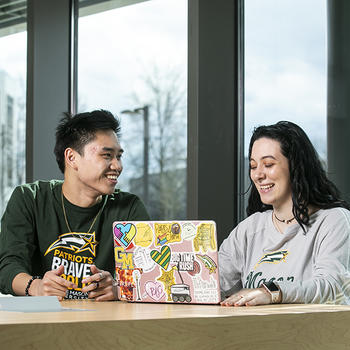
Ads Spring 2022. Photo by: Ron Aira/Creative Services/ George Mason University

That’s where Knack comes in. Starting in fall 2024, George Mason University entered a three-year partnership with Knack, a peer-to-peer tutoring platform. Through Knack, students in any of the 28 participating courses can get up to three hours of free virtual or in-person tutoring from their peers every week during the semester. Participating courses span math, statistics, biology, chemistry, business, economics, and public health.

“We are transforming the support for student success at George Mason by fostering a collaborative learning environment that empowers students to excel academically,” said Vicki Dominick, associate director of George Mason’s Learning Services office, which offers a variety of academic success supports for students, including academic success workshops, online resources and coaching.

Knack does not replace other tutoring services offered by George Mason, Dominick noted. It is an additional resource, allowing more options for meeting times and places. Currently, close to 3,000 students are registered with Knack tutoring, and almost 1,500 tutoring sessions were completed in fall semester.

“This free support is directly in line with George Mason’s mission of access to education,” said Keith Renshaw, senior associate provost for undergraduate education and professor of psychology.

“For my chemistry class, there’s always many students attending office hours, so I don’t get the one-on-one help I need,” said sophomore biology major Khushneet Kaur Kainth. “I’ve been able to get personalized support through Knack.”

There are benefits for the tutors as well. Tutoring through Knack is a paid position, and tutors are required to have passed the class for which they are a tutor with an A- or higher.

“It gives the tutors ‘high impact practice,’ as they gain hands-on experience teaching complex concepts and problem-solving strategies,” explained Renshaw.

Senior biology major Anahita Salehkhou is a tutor for BIOL 213 - Cell Structure and Function, and said of her tutoring experience, “it has given me the perfect opportunity to share my passion for teaching while strengthening my resume as I prepare to apply for dental school. It’s also helping me prepare for the dental admissions test as I get a good refresher on content I’ve already learned and studied.”

Click here to learn more about Knack tutoring.


Student organization recovers more than 1,600 pounds of food from dining halls, campus events

Original post from The George February 21, 2025Katarina Benson

George Mason University has won four consecutive Gold STARS (Sustainability Tracking, Assessment and Rating System) Assessment, and it’s thanks in part to campus systems and organizations such as the Food Recovery Network (FRN).  

Zero Waste Mason, a collaborative university-wide program that aims to reduce waste, has an ambitious goal of diverting 90% or more of university waste from trash disposal. The Food Recovery Network (FRN) is an important part of that equation.

The Food Recovery Network is one of the largest student-led movements against food waste and hunger in the country, focusing on diverting surplus food from college campuses and redistributing it to the local community. Student volunteers work with Mason Dining’s Food Recovery Verified staff to sort, package, and deliver food to the local community and campus partners.  

“We and so many other sustainability organizations are the main impactors on Mason’s sustainability goals, as we are the individuals going out there and doing the work,” said junior Camila Rosales, president of George Mason’s chapter of FRN. 

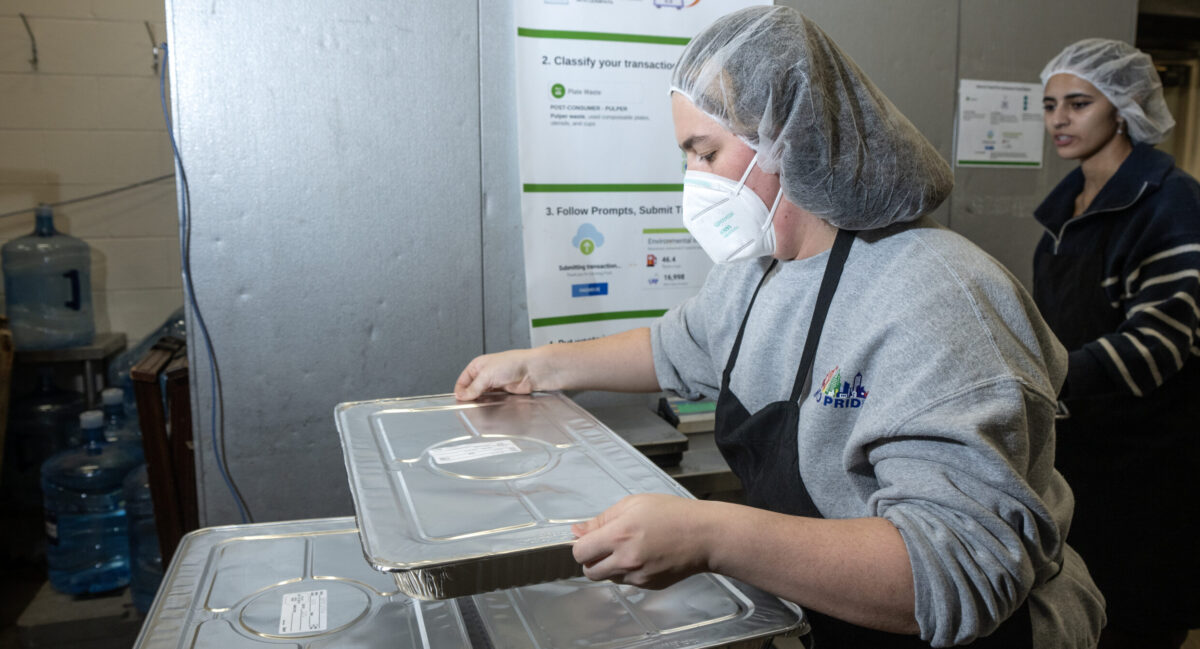
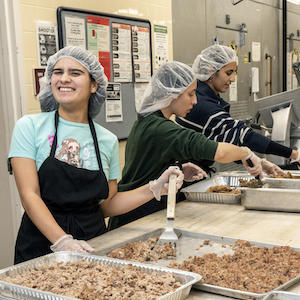
Camila Rosales and students collaborate with Mason Dining’s Food Recovery verified staff to collect, repackage, and deliver surplus food to various donation locations around campus from the Southside Dining Hall on the Fairfax Campus. Photo by Evan Cantwell/Office of University Branding

FRN’s members are committed to sustainability. Before they can volunteer, they are required to complete an online course in food safety and handling.  

Camila Rosales and FRN students in action. Photo by Evan Cantwell/Office of University Branding

Rosales, a business major with a concentration in operations and supply chain management, originally joined the club to fulfill service hours but fell in love with the organization’s mission. Since the chapter began in 2018, they have recovered more than 1,600 pounds of excess food. In the Fall 2024 semester, under Rosales’s leadership, they recovered more than 750 pounds alone and are on track to reach similar numbers in Spring 2025.  

The diverted food is donated to nonprofit organizations in the Northern Virginia community such as New Hope Housing’s Mondloch House, a shelter in Alexandria, and the Katherine Hanley Family Shelter, an emergency family shelter in Fairfax. The club also helps combat food insecurity on campus through Swipe4Change, an end-of-semester Mason Dining initiative that allows students to donate leftover meal swipes and volunteer to collect unused food for Patriots in need. 

“Food Recovery Network’s impact is definitely only something you can see behind closed doors,” said Rosales. 

Rosales, who is also the events director of Her Campus at George Mason and a Costello College of Business Impact Fellow, was encouraged by previous leadership to take on the mantle of president. She fondly remembers the time she showed up to a volunteer shift, without realizing it had been rescheduled, and began processing and packing everything herself.

Students collaborate with Mason Dining’s Food Recovery verified staff to collect, repackage, and deliver surplus food to various donation locations around campus from the Southside Dining Hall on the Fairfax Campus. Photo by Evan Cantwell/Office of University Branding

The chapter’s leadership were so impressed by her efforts that they asked her to become their new president.  

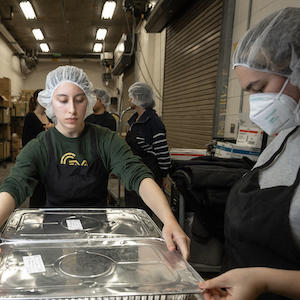
Students repackage food collected from Mason Dining. Photo by Evan Cantwell/Office of University Branding

Rosales said that one of the things that drew her to the organization was helping so many people within that supply chain, she said. “Not only are we donating to these nonprofits, but our dining staff has taken so much time to create this food that being able to make sure food continues on is rewarding. [Joining the FRN] is one of the best decisions I’ve made since entering Mason,” she said.  

As president she oversees all volunteers as well as coordinates communications between FRN’s national leadership, the nonprofit organizations they donate to, and Mason Dining staff. “It’s a lot of emails and managing finances,” she said. “Everything needs to be done almost perfectly, from coordinating [food] drop off times to sanitation.” 

Her main goal for the spring semester is to increase recruitment efforts to be able to make an even greater impact on campus and in the local community. She also wants to expand the chapter to include more opportunities for student connection.  

Rosales highly recommends getting involved with sustainability efforts on campus. "Beyond the service hours, you get to see behind the scenes of where your food comes from (if you eat at the dining halls), and you're supporting the local community." 

Click here to learn about Sustainability at George Mason