
George Mason University is welcoming students back to campus on Jan. 25 for the start of the spring semester. Students, faculty and staff are asked to remember the steps that enabled Mason to have some of the lowest numbers of COVID-19 cases among Virginia’s large universities during the fall. Learn more about what’s planned. Watch the video.
Author: Eleftheria Giannopoulos
Fellow Patriots:
This holiday weekend overflows with irony. When I think of any march on Washington, the image that immediately comes to mind is that of Martin Luther King Jr., arguably America’s greatest leader of non-violent social change, at the base of the Lincoln Memorial.
Contrast that with the images of the more than 25,000 soldiers who currently occupy our capital as a direct result of what former Capitol Police Chief Steven Sund described as a “violent attack … unlike any I have experienced in my 30 years in law enforcement here in Washington, D.C.”
This irony creates many more questions than answers: How did a protest that was supposed to dispute an election get corrupted with guns, multiple Confederate flags, and racists and anti-Semitic slogans? The lack of a meaningful outcry from the protestors and their supporters that these elements did not represent their ideals left many to believe the protestors were in support of the vandalism, hatred and anti-American symbols and sentiments. It’s really illuminating that these were some of the very issues that King fought against.
How can we make sense of a nation that suddenly needs 25,000 troops in its capital just to safeguard the peaceful transition of power from one president to the next?
Is there really an equivalency between the protest in Washington, D.C. this summer following the deaths Ahmaud Arbery, George Floyd, and Breonna Taylor, and the protest on January 6th? Did law enforcement treat these entities as equivalent?
And how on earth do we make sense of this at a time when we are supposed to be reflecting and taking meaningful action toward nonviolent social advancement?
I have found inspiration in the teachings of Dr. King himself, particularly from his Letter From Birmingham City Jail. He wrote it in 1963 as he sat in solitary confinement, having been arrested for peacefully protesting the oppressive segregation of Bull Connor’s Birmingham.
He is described as having felt despair and panic in his isolation. It is evident that many Americans share this sentiment today whether they are protesting police brutality or the election results.
During King’s incarceration, a sympathetic guard smuggled him a newspaper, which contained a scathing open letter to him from eight local clergy, who condemned him as an “extremist,” and his protests as “unwise and untimely.”
Out of his despair, he regained resolve and penned his now-immortal response. Three points in particular resonate with me on this weekend, and I invite you to reflect on them, as well:
Reject violence, no matter what.
In his letter, he described how he and his fellow protestors had to steel themselves for the violence they knew their peaceful protests would draw out. He would tell them: “We adopt the means of nonviolence because our end is a community at peace with itself.”
King goes further to remind us that, “Returning violence for violence multiplies violence, adding deeper darkness to a night already devoid of stars. Darkness cannot drive out darkness; only light can do that. Hate cannot drive out hate; only love can do that.” These statements were lessons for his followers at that time but are equally true in this moment.
Progress toward social justice is not automatic.
“Human progress never rolls in on wheels of inevitability,” Dr. King wrote from his jail cell. It takes constant work and the effective use of time. “We must use time creatively, in the knowledge that the time is always ripe to do right. … Now is the time to lift our national policy from the quicksand of racial injustice to the solid rock of human dignity.”
As we prepare to inaugurate a new president, we have reached a moment of sobering national reckoning about who we have been, who we are, and therefore, in time, who we might become. Just as we were told after each mass shooting over the last decade that “now is not the time” to address the root causes of gun violence in America, Dr. King was chided that his social movement was “untimely.” Waiting was always the advice he would receive, and thankfully reject.
We were not ready for the events of January 6. We as a nation will never be ready, or be comfortable, with the gut-wrenching truths that these events and the social justice events of 2020 now demand that we examine. It is time to stop waiting until we are “ready,” because such a comfortable moment will never present itself.
We are all extremists.
Dr. King initially bristled at being called out as an “extremist.” Then he thought more deeply about it and concluded that anyone who believes wholly in their cause will be characterized as an extremist. And so, he embraced his mantle as an extremist for love, justice, and equality.
“So, the question is not whether we will be extremists, but what kind of extremists we will be,” he wrote. “Will we be extremists for hate or for love? Will we be extremists for the preservation of injustice or for the extension of justice?”
So, Patriots, in keeping with this holiday as a day “on” and not a day “off,” here is a homework assignment for all of us: How can we be extremists for love and the extension of justice? Because today is ripe to do right.
Gregory Washington
President

Dear Parents and Families,
In just a few days the Spring 2021 semester will start, and soon students will return to their residence halls, classes, and activities. We look forward to welcoming students back to campus!
The health, well-being and safety of our students and the entire campus community is our guiding principle. In addition to Mason’s Covid-19 Safe Return to Campus Plan, students recently received an email with information about Mason’s COVID testing strategy for Spring 2021 that described enhancements and changes to the University’s safety plans.
As the nation prepares for Inauguration Day on Wednesday, January 20, and in light of the events at the Capitol on January 6, we want to remind you that the University’s Mason Ready team, comprised of professionals from the Department of Police and Public Safety and Environmental Health & Safety, will continue to monitor conditions and alert our students and families to any concerns that may impact our campus community.
We do not at this time anticipate any disruption to the scheduled start of the spring semester on Monday, January 25. Mason is located over 20 miles from Washington, D.C., and we know that local and federal agencies will have a significant presence in the District in the days ahead.
Residential students who will begin moving back to campus between January 20 – January 24 may schedule (or reschedule) their move-in appointment within the Housing Portal between now and Sunday, January 17. If you anticipate difficulty moving through the District next Wednesday, your student has until this Sunday to make a change to their move-in date.
With best wishes for a safe, healthy and productive Spring Semester,
Rose Pascarell
Vice President, University Life
Vice President, University Life
Dear Patriots,
The start of spring semester is 10 days away, and we are on schedule and ready to get started. I know everyone is eager to put 2020 behind us, and I’m right there with you. But before we turn the page, let’s take a moment to think about all we achieved over the last year.
George Mason University went fully online in March 2020, then demonstrated that we could safely bring our students back to campus for a meaningful fall semester. We kept our COVID cases among the lowest in the Commonwealth, having confirmed fewer than 500 cases of COVID among our 50,000 students, faculty, staff and on-campus contractors since reopening campuses on August 17. We educated and graduated record numbers of students. And we contributed greatly to the national conversation around finding a way out of this pandemic, through our research and our expertise.
Up to this point, our management of the virus has taught all of us that Mason can handle whatever challenge comes our way. Solving problems is what we do, it’s in our DNA. Furthermore, this experience has reminded us that our strength comes from our ability to work together to find solutions. Mason’s commitment to shared governance, shared support and shared responsibility has been instrumental in leading us to this moment.
After considerable conversations with leaders across the university and public health experts, we plan to start the semester on Jan. 25 – as we announced in December and one week later than originally scheduled – with a mix of in-person, online and hybrid classes, and skipping spring break. We did not make this decision lightly. We have spent the past few weeks monitoring data, talking with faculty and staff from across the campus, hearing from many experts in public health on what’s best for our community and directly engaging our scientists relative to predictive models that they have developed. This has helped us determine that we are well-positioned to open and expand our operations through the course of the semester, as conditions allow.
From the fall, we learned that students’ risk of serious illness from COVID-19 was extremely low on college campuses when appropriate precautions are put in place and strictly observed. Two-thirds of the more than 700 colleges surveyed by The Chronicle of Higher Education reopened with in-person instruction in the fall, as we did. Mason was a leader in keeping cases low in the Commonwealth, and we found no evidence of transmission in any significant way in the classrooms, laboratories or lecture halls (this was true overwhelmingly for our peers at other universities). In fact, spikes in cases were found to have most often occurred when students left their campuses during holiday breaks.
Students have made it clear that they want to continue to learn on campus and participate in activities when it is responsible to do so. I know that cases have been rising nationally and regionally since the late fall, and that you want to stay safe. I do, too. We also have a responsibility to be here for our students. They want to continue learning in a safe campus environment while staying engaged with their faculty and peers. I believe this is not an either/or decision and to make it one would be a disservice to our students and a default of our responsibility. We can do both, and the fall semester has helped to solidify that fact.
Given the broader prevalence of the virus in our midst, and the threat of a more contagious strain, we have stepped up our efforts to keep COVID-19 at bay. It starts with a stronger plan for testing led by our faculty.
Large-scale, rapid-results testing, run by Mason faculty
This week, we switched to a saliva test, which is less invasive to administer and quicker to analyze. We are greatly expanding our testing capacity and are now processing test results in a lab on our Science and Technology campus, run by our own esteemed faculty. We will start by testing every residential student a minimum of once per week. It is expected that this testing will ramp up to twice per week by mid-semester. This also allows us to increase the number of faculty, staff and off-campus students participating in surveillance testing, with a total goal of 10,000 tests per week by March, as we shared earlier this week. Our systems will enable faster and more reliable results of asymptomatic cases on campus, which will allow quicker isolation of students, faculty and staff with a goal of limiting any potential spread.
Pretesting residential students
We are also pretesting our residential students this month before they arrive on campus and will require a “soft quarantine” until results are given. After that, students will be tested at least once a week, as noted above.
Pausing on the 50 percent return goal
We have decided to hold off on the goal of having faculty and staff return to campus 50 percent of the time. We will continue with how we operated in the fall and will reevaluate this goal at the end of February, when we have a better sense of the virus and progress made on efforts to vaccinate across the region.
Pivoting to vaccinations
The majority of our faculty and staff are in Group 1c for the vaccine rollout. While we do not have any vaccines and are not currently conducting vaccine distribution, we have been asked to prioritize distribution given our large number of faculty and staff. Toward that end, we will prioritize staff and faculty based on those who are returning to campus regularly or interacting in person with students.
Staying the course to limit the spread
As a community, we have shown that we can all do our part to limit the spread. We will continue wearing face masks in public, staying six feet apart, completing the Mason Daily COVID Health Check, washing hands frequently or using hand sanitizer, and staying home when feeling unwell. Please consult the university’s Safe Return to Campus website for more details on our safety plan.
A great university is the sum of its parts, and everyone’s contributions are essential to our success. We have come so far in this journey, and I’m excited for what the spring semester holds.
Let’s get started!
Gregory Washington
President
Dear Patriots,
George Mason University is making major changes to its testing operation for the Spring 2021 semester that will better safeguard the health and wellness of our community against COVID-19.
Our efforts in the fall made Mason a model for success in managing the virus, and that is a direct credit to our students, faculty and staff who did a tremendous job adapting to this new environment. We also know that the number of cases continues to rise nationally and regionally. So, it is important that we all remain vigilant and continue to do our part to help keep Mason safe.
Testing is at the core of our safety plan. As announced last month by President Washington, this spring we plan to greatly expand our capacity. We are also moving to a saliva-based PCR test (effective Jan. 11 in Fairfax and Jan. 25 for the Arlington and SciTech campuses) and will have Mason researchers process the test results in laboratories on the SciTech campus. These changes will help us get a faster and more accurate picture of the virus, and help us limit the spread at Mason.
Collecting representative samples is the key to accurately determining the prevalence of COVID in the Mason community, so your participation is strongly encouraged. Please read on to learn about the changes and how you can help stop the spread.
Advantages to saliva-based testing
We began moving to a saliva test this week to increase our testing capacity from 1,000 tests per week to a goal of 10,000 per week by March. These are the random surveillance tests that we are using to track asymptomatic cases on our campus. They are also easier and more comfortable to administer and allow for faster analysis.
Samples will be analyzed at SciTech at the College of Science’s Center for Applied Proteomics and Molecular Medicine CAP/CLIA certified laboratories, so turnaround time for results should be reduced to an average of 2 business days or less.
Where to go for testing
We are expanding to five testing sites for random, surveillance testing across our campuses:
- The former first floor library in the Johnson Center opened Jan. 11 for testing of residential students, non-residential students, faculty and staff.
- Merten Hall, Room 1204 opens Jan. 19 for testing non-residential students, faculty and staff.
- The former MIX space in Fenwick Library opens Jan. 25 for testing residential students.
- In Arlington, Van Metre Hall, Room 308 opens Jan. 26 for testing non-residential students, faculty and staff. Testing will be conducted on Tuesdays and Wednesdays.
- At SciTech, Randall’s Café in Colgan Hall opens Jan. 25 for testing residential and non-residential students, faculty and staff. Testing will be conducted on Mondays and Thursdays.
Surveillance testing for the Athletics department will remain in the Field House on the Fairfax Campus. The Ángel Cabrera Global Center parking garage will no longer be used for testing.
Everyone who participates in the surveillance testing must be prepared to show their Mason ID with their G number, confirmation of their appointment, and a green Mason COVID Health Check™ screening.
Where do you go for a test if you are symptomatic?
Students who are symptomatic or are identified as close contacts of someone who tested positive for coronavirus will be tested at Rogers Hall in the former Subway location. This testing site opened Jan. 11 and is strictly for student diagnostic tests ordered by Student Health Services.
Faculty and staff who are symptomatic should contact their health care provider for testing.
How to participate in surveillance testing
Residential students
Students living on-campus will be tested weekly (unless an exemption has been granted) and will sign up for testing using the Patriot Course Scheduler. Residential students will need to show a negative test result before moving into residence halls. Housing and Residential Life will contact residential students this week with more information about the testing process.
Non-residential students, faculty and staff
Members of our student population who live off-campus, as well as faculty and staff, will be selected for weekly testing through a randomized process based on their risk group, which is based on their on-campus activities. Your daily completion of the COVID Health Check™ helps us understand who is coming to campus and when.
Participants will receive an email from [email protected] that informs them they have been selected with a link to the test information sheet, as well as a link to the Medicat portal. As part of the testing strategy, everyone will be asked to update their profile in Medicat, the electronic health record system.
Please be aware that the saliva test requires you to refrain from eating or drinking for 30 minutes before you provide your sample, unless you have a medical condition that prevents you from meeting this guideline. If you do not adhere to this guideline, it may affect the accuracy of your result, requiring a repeat of your test.
Receiving test results
After the sample is analyzed, participants will receive an email with instructions for logging in to the Student Health Services Patient Portal to view and print results.
Students who test positive will be contacted by Student Health Services. Faculty and staff who test positive will be contacted by Safety, Emergency, and Enterprise Risk Management. Please follow health department and health professional guidance to isolate when you are positive, this protects our entire community.
In the rare case when a test is inconclusive, the participant will receive a secure message with instructions for scheduling a new time for sample collection.
Vaccination priority groups
We know many of you have questions about the timeline for vaccinations for our community. The Virginia Department of Health, in partnership with local health departments, is leading this effort and we are assisting on our campuses. Here are the broad categories with details as they relate to the Mason community.
Category 1a: This group is front-line health care providers. At Mason, these are front-line healthcare workers, testing staff, faculty and lab employees who are supporting testing and mental health practitioners. These employees have already been contacted.
Category 1b: This group includes child care workers and first responders at Mason, including police. They will be contacted this week.
Category 1c: Most Mason faculty and staff. You can find out more about the priority groups using this tool from the Virginia Department of Health. Mason is coordinating with the health departments in Arlington, Prince William County and Fairfax County; employees will be included in population totals based on their primary campus.
Employees are encouraged to register for the vaccine with their local health department. The university is exploring additional opportunities to provide vaccine to our community. If the university can provide vaccine or access to vaccination, information will be shared as soon as it becomes available. We know many members of our community are eager to get the vaccine and we will continue to share new information as we receive it.
Flexibility is key
As part of our regular communication with department officials, we are closely monitoring positivity rates and other key metrics. If a change needs to be made to our Spring 2021 plan, it will be communicated it to the university community on Friday, Jan. 15.
We appreciate everyone’s commitment to completing the daily Mason COVID Health Check™, wearing face coverings, keeping at least six feet apart, frequent hand washing or use of hand sanitizer, and staying home when feeling unwell.
Thank you for doing your part to keep Mason safe and healthy.
Sincerely,
Julie Zobel, PhD
Associate Vice President for Safety, Emergency, and Enterprise Risk Management
Fellow Patriots:
Tonight more than ever we need to be Patriots with a capital P. It’s easy to feel helpless at the events that unfolded just east of our campuses today, but we can be of service to our communities and our nation.
To be clear, we are living through a moment in our American history that we can scarcely comprehend as it unfolds. Network news outlets show our US Capitol building overtaken while our leaders exercise a cherished ritual of our democracy. They are using words such as “coup attempt” and “insurrection.” And they are reminding us that America has not experienced such a seizure of its Capitol building since the British sacked it in the War of 1812.
Many of us are also struggling to reconcile the dissonance of this response with that of protests that occurred in Washington last year. Those legal acts of civil disobedience provoked far more violent and forceful law enforcement actions. We are left with far more questions than answers tonight.
History in the moment rarely makes sense, and it can easily evoke intense emotions that invite reactions of raw passion. But the fact remains that today’s events are still a shared experience for all of us as Americans, even though we view them as a deeply divided nation. Through it all, we are all still in this American experience together.
What can we do as a university community? First, we must stay safe, take care of ourselves, and look out for each other in this moment of extreme volatility. Second, we have to remind ourselves and each other that we will make it through this and come out a better nation – because we always do.
And finally, we are a university, which gives us both great privilege and a great responsibility to observe, learn, teach, and act as first interpreters of moments such as these, with all of their violence, complexity, contradictions, and ambiguities.
The nation is struggling to understand what is happening, how to react, and how to move beyond this. Academic communities like Mason’s are at their best when they step into moments like these to offer perspective, clarity, and when necessary, hard truths that force us to grow even as we seek to heal.
So tonight, be safe and be well. And when this moment has passed, Patriots, let’s get back to work, doing what we do best.
Sincerely,
Gregory Washington
President

George Mason University’s ADVANCE program, which partners with Northern Virginia Community College (NOVA) to help students earn four-year degrees at Mason, is celebrating its first four graduates next week.
The ADVANCE graduates are Amir Bhatti, Rocio Cornero, Erica Koprowski and David Kowalewski.
“I am very proud of these graduates,” said Ashlie Prioleau, executive director of the ADVANCE program. “They thought strategically about their education and how to achieve a Mason degree while spending less money for it. They are dedicated to their education, intelligent, determined. To achieve this important milestone in a pandemic means these students are tenacious.”
Dear Patriots,
We are nearing the end of a remarkably successful fall semester, especially considering where we started and what we’ve been through. Just five months ago, our greatest challenge was figuring out how we could deliver a Mason education to a record number of students during a global pandemic. Now, in two weeks, we will graduate a class at winter commencement that includes more than 4,600 graduates and more than 5,000 when counting students earning certificates.
We have achieved so much this fall, even as the coronavirus has shut down operations at many other universities. As of Sunday, we had just 35 active cases in our community – 24 students (most of them off campus) and 11 employees and contractors. For the entire Fall semester, we had just 46 cases among our residential students, and to the best of our knowledge, we experienced no known cases of transmission in the classrooms.
Our ability to keep Mason safe and focused on our mission is a credit to our students, faculty and staff. Together, we have kept cases relatively low and Mason operating. Our efforts are working, and we must continue to work together to keep Mason safe.
For the final weeks of the Fall semester, we have switched over to virtual instruction, as planned. Yet we continue to stay vigilant. Next week, we will test the nearly 1,300 residential students who have elected to remain on campus through the end of the semester. This is an important component of our safety plan to see if there was any impact from the Thanksgiving break.
As we look ahead to the Spring semester, I’d like to share some important changes that will help us continue to keep our community safe.
Spring semester will begin on January 25, and we will work through Spring Break. In consultation with the Faculty Senate and our leadership, we have decided to push the start date for the Spring semester back one week and will work through Spring Break. This will allow more time to assess the number of cases in the region before bringing students back, and will also limit travel away from campus during the semester.
Ramping up our surveillance testing operations to identify cases early. The number of coronavirus cases has risen sharply across the nation in recent weeks and health officials project cases will continue to rise through the winter months. We have managed to keep cases low at Mason, in large part because of our commitment to random, surveillance testing. Now, we plan to raise our weekly testing capacity, increasing from 1,000 tests per week this semester and setting a goal to test 10,000 people per week by March. We will be able to scale up our testing capacity each week by switching to a saliva test, which is faster, easier to administer and safer. Increased testing allows us to pinpoint problem areas, limit spread and create a safer environment. We will do this by:
- Working toward testing all residential students a minimum of once per week.
- Testing more faculty, staff, non-residential students (10-20 percent) each week.
- Increasing diagnostic testing to meet anticipated growth in cases.
Mason faculty will now be leading our testing operations. I am pleased to announce that Drs. Ali Andalibi, Lance Liotta and Virginia Espina – three of our most esteemed faculty members – will be overseeing an in-house surveillance testing analysis at the Mason CAP/CLIA laboratory, which will dramatically shorten turnaround time for results. This is an important change in our operations, one that will allow us to rely on the expertise of our faculty and aligns with my goal to expand research in areas of critical importance.
The healthcare professionals at Student Health Services, led by Dr. Lisa Park, will continue to lead diagnostic testing and ensure appropriate clinical management of students with positive results, including proper isolation and quarantine.
We will be sending out more details in January on our testing operations.
A safer environment will allow us to bring more people back to campus. Our testing and safety efforts this fall, and a close relationship with Fairfax County Health Department, were instrumental in keeping case counts low. Therefore, as conditions allow, we will continue to observe our safety precautions and work to bring more students, faculty and staff back to campus this spring. This includes increasing in-person instruction, increasing the number of occupants in our residence halls and setting a goal to have faculty and staff work up to 50 percent of their time on campus, in accordance with our public health professionals and if conditions allow. We know that students are asking for more opportunities to engage on campus, and we will continue to work to provide them, as long as we can do so in a safe environment.
We are exploring an idea to add Patriot Learning Pods for school-age children. As I have previously mentioned, our goal is to allow for more faculty and staff to work on campus in the spring. I’m also well aware of many challenges that parents of school-aged children face with most schools still operating partially or fully virtually.
To address these challenges, we are exploring the idea of adding Patriot Learning Pods on campus. Patriot Learning Pods would provide a safe, supervised space where elementary school children of Mason students, faculty, and staff could complete online schoolwork while their parents are on campus. Our Human Resources team recently sent out a survey to gauge interest, and it appears this would be something of interest to many of our faculty and staff, so expect to see an update from HR soon.
We are prepared to pivot to all-virtual instruction this spring, if necessary. Our leadership team continues to monitor the number of cases in the region and is in close contact with public health officials. As always, we will follow their guidance and are prepared to pivot to virtual instruction at any moment, if we determine that is in the best interest of our community. Safety remains a top priority.
We have so much to be thankful for this holiday season. At the top of my list is this incredible community that I’m now a part of. Let’s continue to do our part: wear a mask in public; practice physical distancing, complete the Mason COVID Health Check™, and if you feel unwell, isolate and call your healthcare provider. If you have had exposure to COVID-19, abide by medical and public health recommendations, and quarantine.
Let’s continue to keep Mason safe together. Thank you.
Sincerely,
Gregory Washington
President
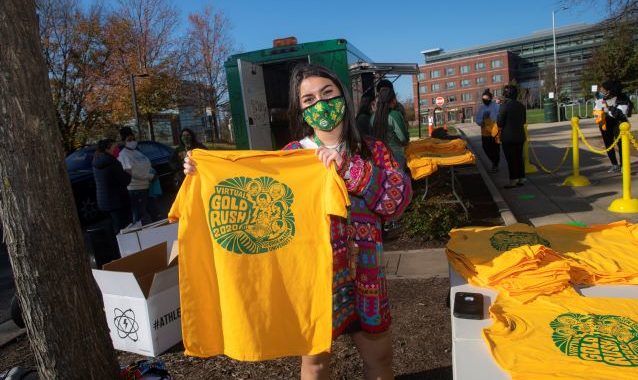
Gold Rush at Mason traditionally signals the start of basketball season. Mason students weren’t about to let the global pandemic prevent them from showing their school spirit, and they turned out for four days of Virtual Gold Rush 2020 festivities, including T-shirt giveaways, a virtual murder mystery, virtual Kahoot and a weekend-long treasure hunt, all from Nov. 11-15.
The events were jointly hosted by Student Involvement, University Life and Student Government.
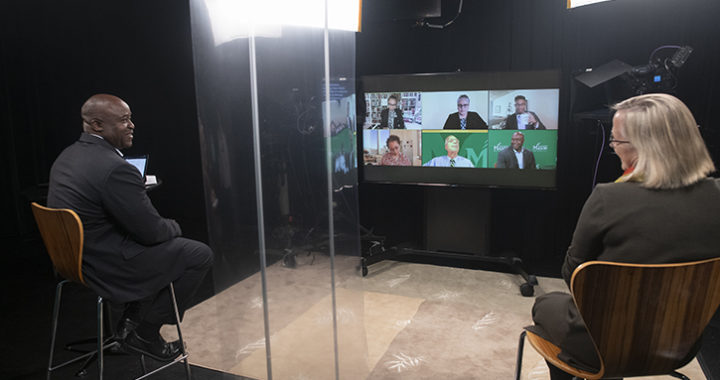
Understanding what anti-racism, diversity and inclusion mean for George Mason University was just one of the goals of Monday’s Freedom and Learning forum hosted by President Gregory Washington.
Ensuring a common definition of the terms helps create meaningful dialogue, and helps the Mason community understand the work of the Anti-Racism and Inclusive Excellence Task Force. The group was formed by Washington in response to both the high-profile death of George Floyd at the hands of police and the nationwide racial justice movement.
“We shouldn’t – we cannot – run away from these discussions,” Washington said. “We have to have engagement on these topics.”